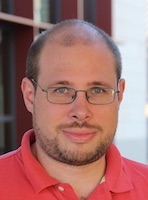
I am a postdoctoral fellow at the U.S. Army Research Lab in Adelphi, MD.
My research broadly addresses the tools, methods, and applications of quantum technology from a theoretical and numerical perspective. Currently, I am working on applications of machine learning to quantum control, and on the design of robust quantum sensing devices.
Previously, I was a postdoc with Hideo Mabuchi at Stanford, working on optimal control of quantum networks, after completing my PhD in the group Christiane Koch, working on optimal control of quantum gates in open quantum systems.
 Optimizing Robust Quantum Gates in Open Quantum Systems.
Submitted January 2015 to the Fachbereich Mathematik und Naturwissenschaften, Universität Kassel.
[ A4 | letter | A4 two-sided | letter two-sided | Github ]
 Sebastian C. Carrasco, Michael H. Goerz, Svetlana A. Malinovskaya, Vladan Vuletic, Wolfgang Schleich, and Vladimir S. Malinovsky
Dicke State Generation and Extreme Spin Squeezing via Rapid Adiabatic Passage.
Phys. Rev. Lett. 132, 153603 (2024).
[ DOI | arXiv | PDF ]
 Bineet Dash, Michael H. Goerz, Alisher Duspayev, Sebastian C. Carrasco, Vladimir S. Malinovsky, and Georg Raithel
Rotation Sensing using Tractor Atom Interferometry.
AVS Quantum Science 6, 014407 (2024).
[ DOI | arXiv | PDF ]
 Michael H. Goerz, Mark A. Kasevich, and Vladimir S. Malinovsky
Robust Optimized Pulse Schemes for Atomic Fountain Interferometry.
Atoms 11, 36 (2023).
Special issue on Advances in and Prospects for Matter Wave Interferometry.
[ DOI | arXiv | PDF ]
 Michael H. Goerz, Sebastián C. Carrasco, and Vladimir S. Malinovsky
Quantum Optimal Control via Semi-Automatic Differentiation.
Quantum 6, 871 (2022).
[ DOI | arXiv | PDF | Github ]
 Georg Raithel, Alisher Duspayev, Bineet Dash, Sebastián C. Carrasco, Michael H. Goerz, Vladan Vuletić, and Vladimir S. Malinovsky
Principles of tractor atom interferometry.
Quantum Sci. Technol. 8, 014001 (2022).
[ DOI | arXiv | PDF ]
 Sebastián C. Carrasco, Michael H. Goerz, Zeyang Li, Simone Colombo, Vladan Vuletić, and Vladimir S. Malinovsky
Generating Extreme Spin Squeezing.
Phys. Rev. Applied 17, 064050 (2022).
[ DOI | arXiv | PDF ]
 Michael H. Goerz, Mark A. Kasevich, and Vladimir S. Malinovsky
Quantum optimal control for atomic fountain interferometry.
Proc. SPIE 11700, Optical and Quantum Sensing and Precision Metrology (2021).
[ DOI | PDF ]
 Michael H. Goerz, Daniel Basilewitsch, Fernando Gago-Encinas, Matthias G. Krauss, Karl P. Horn, Daniel M. Reich, and Christiane P. Koch
Krotov: A Python implementation of Krotov's method for quantum optimal control.
SciPost Phys. 7, 80 (2019).
[ DOI | arXiv | PDF | Github ]
Michael H. Goerz and Kurt Jacobs
Efficient optimization of state preparation in quantum networks using quantum trajectories.
Quantum Sci. Technol. 3, 045005 (2018).
[ DOI | arXiv | PDF ]
 Arman A. Setser, Michael H. Goerz, and Jason P. Kestner
Local gradient optimization of modular entangling sequences.
Phys. Rev. A 97, 062339 (2018).
[ DOI | arXiv | PDF ]
 Michael H. Goerz, Felix Motzoi, K. Birgitta Whaley, and Christiane P. Koch
Charting the circuit QED design landscape using optimal control theory.
npj Quantum Information 3, 37 (2017).
[ DOI | arXiv | PDF ]
 Michael H. Goerz, K. Birgitta Whaley, and Christiane P. Koch
Hybrid Optimization Schemes for Quantum Control.
EPJ Quantum Tech. 2, 21 (2015).
[ DOI | arXiv | PDF ]
Paul Watts, Jiří Vala, Matthias M. Müller, Tommaso Calarco, K. Birgitta Whaley, Daniel M. Reich, Michael H. Goerz, and Christiane P. Koch
Optimizing for an arbitrary perfect entangler: I. Functionals.
Phys. Rev. A 91, 062306 (2015).
[ DOI | arXiv | PDF ]
Michael H. Goerz, Giulia Gualdi, Daniel M. Reich, Christiane P. Koch, Felix Motzoi, K. Birgitta Whaley, Jiří Vala, Matthias M. Müller, Simone Montangero, and Tommaso Calarco
Optimizing for an arbitrary perfect entangler. II. Application.
Phys. Rev. A 91, 062307 (2015).
[ DOI | arXiv | PDF ]
 Michael H. Goerz, Eli J. Halperin, Jon M. Aytac, Christiane P. Koch, and K. Birgitta Whaley
Robustness of high-fidelity Rydberg gates with single-site addressability.
Phys. Rev. A 90, 032329 (2014).
Editor's suggestion.
[ DOI | arXiv | PDF ]
Georg Jäger, Daniel M. Reich, Michael H. Goerz, Christiane P. Koch, and Ulrich Hohenester
Optimal quantum control of Bose-Einstein condensates in magnetic microtraps: Comparison of GRAPE and Krotov optimization schemes.
Phys. Rev. A 90, 033628 (2014).
[ DOI | arXiv | PDF ]
 Henning A. Fürst, Michael H. Goerz, Ulrich G. Poschinger, Michael Murphy, Simone Montangero, Tommaso Calarco, Ferdinand Schmidt-Kaler, Kilian Singer, and Christiane P. Koch
Controlling the transport of an ion: Classical and quantum mechanical solutions.
New J. Phys. 16, 075007 (2014).
Special issue on coherent control of complex quantum systems.
[ DOI | arXiv | PDF ]
Michael H. Goerz, Daniel M. Reich, and Christiane P. Koch
Optimal control theory for a unitary operation under dissipative evolution.
New J. Phys. 16, 055012 (2014).
Special issue on coherent control of complex quantum systems.
[ DOI | arXiv | PDF ]
Michał Tomza, Michael H. Goerz, Monica Musiał, Robert Moszyński, and Christiane P. Koch
Optimal production of ultracold ground-state molecules: Stabilization employing potentials with ion-pair character and strong spin-orbit coupling.
Phys. Rev. A 86, 043424 (2012).
[ DOI | arXiv | PDF ]
 Michael H. Goerz, Tommaso Calarco, and Christiane P. Koch
The Quantum Speed Limit of Optimal Controlled Phasegates for Trapped Neutral Atoms.
J. Phys. B 44, 154011 (2011).
Special issue on quantum control theory for coherence and information dynamics.
[ DOI | arXiv | PDF ]
 May 2024, Quantum Optimal Control Workshop, Berlin, Germany, invited talk:
Modernizing the Quantum Control Stack with QuantumControl.jl.
[ PDF ]
 July 2023, JuliaCon, Cambridge, MA, USA, talk:
Quantum Dynamics and Control with QuantumControl.jl.
[ PDF | Youtube | Github ]
 June 2023, DAMOP, Virtual, talk:
Optimal Control of a Sagnac Tractor Atom Interferometer.
[ PDF | Youtube | Github ]
 March 2023, APS Spring Meeting, Virtual, talk:
QuantumControl.jl: A modern framework for quantum optimal control.
[ PDF | Youtube | Github ]
 August 2022, CQE Workshop on Scalable Quantum Control, Chicago, IL, USA, talk:
Scalable Quantum Control with Semi-Automatic Differentiation.
[ PDF ]
 August 2019, Gordon Research Conference, Newport, RI, USA, poster:
Optimal Control for Robust Atom Interferometry.
[ PDF ]
March 2019, APS Spring Meeting, Boston, MA, USA, talk:
Optimal Control for Robust Atomic Fountain Interferometers.
[ PDF ]
 January 2019, Photonics for Quantum Workshop, Rochester, NY, USA, poster:
Optimal Control for Robust Atomic Fountain Interferometry.
[ PDF ]
 August 2018, Army Science and Technology Symposium and Showcase, Washington, DC, USA, talk:
Optimal pulse schemes for high-precision atom interferometry.
[ PDF ]
 July 2018, Scipy: Scientific Computing with Python, Austin, TX, USA, poster:
A Quantum Toolchain.
[ PDF ]
 May 2018, DAMOP, Fort Lauderdale, FL, USA, poster:
Optimal Control for High-Precision Atom Interferometry.
[ PDF ]
August 2017, Gordon Research Conference, Mount Holyoke, MA, USA, invited talk:
Efficient Numerical Optimization via Quantum Trajectories.
[ PDF ]
August 2017, Gordon Research Conference, Mount Holyoke, MA, USA, poster:
Charting the cQED Design Landscape Using Optimal Control Theory.
[ PDF ]
September 2016, CECAM Workshop, Berlin, Germany, invited talk:
Optimal Control for Quantum Networks.
[ PDF ]
 April 2016, IMA Quantum and Nano Control Workshop, Minneapolis, MN, poster:
Quantum Networks: Analysis, Simulation, and Applications.
[ PDF ]
 January 2016, AHPCRC RMB Review, Stanford, CA, poster:
Building a Software Toolchain for Quantum Networks.
[ PDF ]
 September 2015, Frontiers 2015 Workshop, UMD, College Park, MD, poster:
Charting the cQED Design Landscape using Optimal Control.
[ PDF ]
 April 2014, QUAINT meeting, Sandbjerg Estate, Denmark, talk:
Efficient Optimal Control for Robust Quantum Gates in Liouville Space.
[ PDF ]
 March 2014, DPG spring meeting, Berlin, Germany, talk:
Efficient Optimal Control for a Unitary Operation under Dissipative Evolution.
[ PDF ]
March 2014, DPG spring meeting, Berlin, Germany, poster:
Efficient Optimization of Quantum Gates for Rydberg Atoms and Transmon Qubits under Dissipative Evolution.
[ PDF ]
 July 2013, QIPC "Quantum Information Processing and Communication International Conference", Florence, Italy, poster:
Efficient Optimization of Quantum Gates in the Presence of Decoherence.
[ PDF ]
 June 2013, 536th W.E. Heraeus Seminar "Optimal Control of Quantum Systems", Bad Honeff, Germany, invited talk:
Minimal Set of States for Optimizing Quantum Gates in Open Quantum Systems.
[ PDF ]
 April 2013, "New Trends in Complex Quantum System Dynamics", Cartagena, Spain, poster:
Optimal Control of Transmon Qubit Gates in the Presence of Decoherence.
[ PDF ]
November 2012, 519th WE-Heraeus Seminar "Hybrid Quantum Systems", Bad Honeff, Germany, poster:
Optimal Control of Transmon Qubit Gates in the Presence of Decoherence.
[ PDF ]
 February 2012, AQUTE Winterschool on Quantum Information Processing, Obergurgl, Austria, poster:
Optimal Control of Quantum Gates under Decoherence.
[ PDF ]
 October 2011, Engineering and Control of Quantum Systems Workshop, Dresden, Germany, poster:
Role of dissipation for optimal control of Rydberg Gates.
[ PDF ]
 July 2011, SUSSP67 Summer School "Quantum Information and Coherence", Glasgow, UK, poster:
Optimal Controlled Phasegates for Ultracold Atoms in an Optical Lattice at the Quantum Speed Limit.
[ PDF ]
March 2011, DPG Spring Meeting, Dresden, Germany, talk:
Optimal Controlled Phasegates for Trapped Neutral Atoms at the Quantum Speed Limit.
[ PDF ]
 November 2010, Cambridge Workshop on Algorithms for Quantum Control, Cambridge, UK, talk:
Comparison of GRAPE/LBFGS and Krotov in a High-Dimensional Hilbert Space.
[ PDF ]
 November 2010, French-German Laser Colloquium, Berlin, Germany, poster:
Optimal Controlled Phasegates for Ultracold Atoms in an Optical Lattice at the Quantum Speed Limit.
[ PDF ]
 June 2010, PRACQSYS 2010, Sønderborg, Denmark, poster:
Implementation of a Controlled Phasegate for Ultracold Calcium Atoms Using Optimal Control.
[ PDF ]
March 2009, DPG Spring Meeting, Hamburg, Germany, poster:
Construction of a Fast Two-Qubit Gate for Ultracold Atoms Using Optimal Control.
[ PDF ]
 August 2023, Quantum Computer Systems (QuCS) Lecture Series, invited talk:
Numerical Methods of Optimal Quantum Control.
[ PDF | Youtube ]
 March 2018, Rigetti Computing Seminar, Berkeley, CA, USA, invited talk:
Designing Quantum Technology with Optimal Control.
[ PDF ]
 April 19, 2017, UMBC Physics Colloquium, University of Maryland, Baltimore County, MD, USA, invited talk:
Optimal Control for Entangling Quantum Gates.
[ PDF ]
 November 10, 2015, ARL Quantum Seminar, Adelphi Laboratory Center, MD, USA, talk:
Introduction to Circuit QED.
[ PDF ]
 October 23, 2015, Physical Sciences Seminar, IBM Watson Research Lab, NY, USA, invited talk:
Charting the circuit QED design landscape using optimal control theory.
[ PDF ]
 December 11, 2013, Whaley group seminar, UC Berkeley, USA, invited talk:
Optimal Control Theory for Quantum Gates with Rydberg Atoms and Superconducting Qubits under Dissipative Dynamics.
[ PDF ]
 May 31, 2011, Theory Colloquium, Uni Kassel, Germany, talk:
Optimal Controlled Phasegates for Trapped Neutral Atoms at the Quantum Speed Limit.
[ PDF ]
May 16, 2011, Koch group seminar, Uni Kassel, Germany, talk:
Chebychev Propagator for Inhomogeneous Schrödinger Equations.
[ PDF ]
June 8, 2010, Koch group seminar, FU Berlin, Germany, talk:
Introduction to the GRAPE Algorithm.
[ PDF ]
January 11, 2010, Koch group seminar, FU Berlin, Germany, talk:
Implementation of a Calcium Phasegate.
[ PDF ]
Optimization of a Controlled Phasegate for Ultracold Calcium Atoms in an Optical Lattice.Submitted April 2010 to the Fachbereich Physik, Freie Universität Berlin.
[ PDF ]